

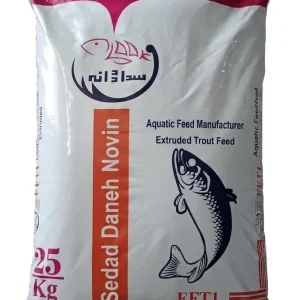


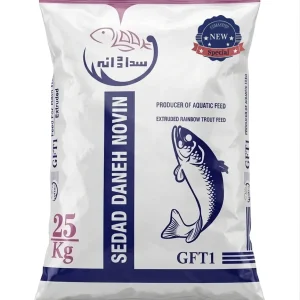


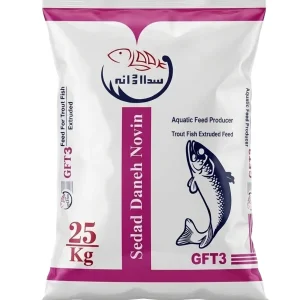
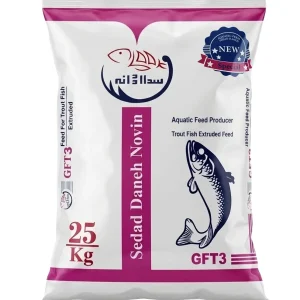

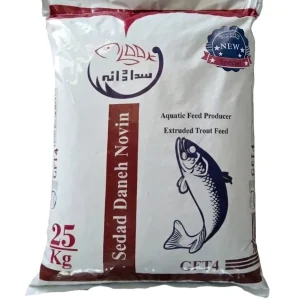
Economical and sustainable production in rainbow trout farms requires access to feed that goes beyond meeting basic nutritional needs and guarantees biological and physical water quality indices. Sadad Daneh Novin company, by employing advanced twin-screw extrusion lines and a scientific formulation based on ideal amino acids, produces various types of extruded rainbow trout feed with the highest water stability index and minimal nutrient loss in water.
The precise thermo-mechanical processing in Sadad Daneh feeds, through complete starch gelatinization and vacuum fat coating, provides maximum digestibility and an optimized feed conversion ratio (FCR). This advantage directly prevents pool water turbidity and capital waste by reducing nitrogen and phosphorus loads.
To inquire about the daily price of rainbow trout feed, receive specialized analysis tables, and purchase directly from the Sadad Daneh Novin factory, please contact our technical experts to select the best dietary regimen tailored to your biomass, water temperature, and farming system (traditional or recirculating).
Economical and sustainable production in rainbow trout farms requires access to feed that goes beyond meeting basic nutritional needs and guarantees biological and physical water quality indices. Sadad Daneh Novin company, by employing advanced twin-screw extrusion lines and a scientific formulation based on ideal amino acids, produces various types of extruded rainbow trout feed with the highest water stability index and minimal nutrient loss in water.
The precise thermo-mechanical processing in Sadad Daneh feeds, through complete starch gelatinization and vacuum fat coating, provides maximum digestibility and an optimized feed conversion ratio (FCR). This advantage directly prevents pool water turbidity and capital waste by reducing nitrogen and phosphorus loads.
To inquire about the daily price of rainbow trout feed, receive specialized analysis tables, and purchase directly from the Sadad Daneh Novin factory, please contact our technical experts to select the best dietary regimen tailored to your biomass, water temperature, and farming system (traditional or recirculating).
Description: The most important classification section to cover long-tail keywords and guide users to products.
At Sadad Daneh Novin, we believe that rainbow trout nutrition is a dynamic process dependent on biological variables. The nutrient requirements of fish change significantly at each stage of their life cycle (from growth to broodstock). Our scientific product categorization helps you manage feed waste and operational costs scientifically by selecting the most precise ration for each phase, while achieving maximum genetic potential.
The growth period is the most critical stage in determining survival rates and the establishment of the fish’s immune system. Sadad Daneh Novin growth feeds (FFT1, FFT2) are produced with precise control to provide maximum surface area for digestive enzymes. In this formulation, the protein-to-energy ratio is adjusted to prevent excessive metabolic loading on growing fish (F1, F2). The use of high-quality protein sources, along with immune-boosting additives, ensures that the fish gain a robust physical structure and high resistance to environmental stresses and diseases in the first weeks of growth.
In the growth phase, where the majority of the farm’s biomass is formed, our main focus is on “maximum utilization of received energy.” Sadad Daneh Novin growth rations, through precise engineering of Digestible Energy (DE) and adjustment of limiting amino acid profiles (especially lysine and methionine), compel the fish to store protein in the muscle. This means rapid conversion of feed to muscle with minimal nitrogenous waste in the water. Feeds in this category are designed with standard sizing to be fully compatible with the fish’s feeding behaviors in this phase, maintaining high growth rates while keeping liver and kidney health indices at the best possible level.
The final stage is not just about weight gain, but about improving “marketability.” Our finisher formulation is designed to focus on fillet texture and carcass quality in addition to increasing growth rates. At this stage, by adjusting the oil application rate and using natural antioxidants, we prevent excessive accumulation of unsaturated fats in the fish’s abdomen. This strategy, while preserving liver health, causes the fillet texture to firm up and increases carcass shelf-life after harvest; a factor that directly impacts your profitability during wholesale.
Broodstock have completely different nutritional needs that are directly related to the “next generation.” Sadad Daneh Novin broodstock feed is enriched with a high concentration of essential fatty acids, EPA and DHA, to guarantee egg quality and sperm motility. A special blend of fat-soluble vitamins (especially Vitamin E and organic selenium) is included in this ration to increase hatching rates and ensure that the resulting larvae possess higher-quality yolk reserves. With this ration, we manage your farm’s reproductive quality from the very source.
Feeding strategies must be calibrated to your “farming system”:
Many farmers, in their financial analyses, only consider the “price per kilogram of feed” as a benchmark; however, the reality is that true profitability depends on the “production cost per kilogram of fish.” Sadad Daneh Novin extruded feeds, by focusing on biological efficiency, transform your farm’s economic parameters from a cost center into an optimized production unit.
Our advanced formulation is designed with the aim of reducing the Feed Conversion Ratio (FCR). When feed has high digestibility and a precise amino acid balance, the fish spends the most energy on muscle building and minimizes nutrient excretion. This means that with every kilogram of Sadad Daneh feed, you experience more weight gain compared to low-quality, inexpensive feeds. By reducing the FCR by even 0.1 units, your final profitability over the entire production cycle increases significantly; this is the intelligent management of cost per kg gain that makes a huge difference in a farm’s balance sheet on an industrial scale.
Every gram of feed that is not digested in the water is excreted as organic matter (nitrogen and phosphorus) and degrades water quality. Sadad Daneh Novin feeds, due to high physical stability and excellent absorption, drastically reduce the “organic load” of the pond. This advantage directly reduces your ancillary costs:
The selection of feed size (from growth to rearing and broodstock feeds) should be based on the “gape size” of the fish to prevent swallowing stress and energy waste. Generally, the feed diameter should be approximately one-third to one-half of the fish’s mouth width. For fish weighing 5 to 50 grams, 1.5 to 2 mm feeds are recommended, and for rearing fish over 100 grams, 3 to 5 mm sizes are advised. Sadad Daneh Novin experts suggest the optimal size based on your stock’s precise biometry.