
Introduction: The Strategic Role of Scientific Nutrition in Industrial Aquaculture Economy
In modern aquaculture, particularly in dense and super-dense farming systems, managing trout nutrition is the heartbeat of farm profitability. Since over 60 to 70 percent of the operational costs in farms are directly attributed to feed costs, any improvement in the formulation and physical properties of feed will have a remarkable impact on the final profit margin.
Today, achieving an optimal feed conversion ratio (FCR) is not solely reliant on the provision of macronutrients; it requires a balance of the bioavailability of amino acids, the profile of essential fatty acids, and high-efficiency digestion of extruded feed. Coldwater fish feed produced by Sedad Daneh Novin, based on advanced formulations, demonstrates exceptional stability in water and maintains feed durability, minimizes substrate waste, and prevents the decline of water quality in high-density farms.
Choosing an engineered feed not only enhances the immune system and specific growth rate (SGR) but also controls biological decline and conversion ratios, ensuring capital efficiency in competitive markets. Sedad Daneh Novin combines cutting-edge diet formulation knowledge with modern extrusion processing technology, providing economic sustainability and biosphere-focused production for pioneering growers.
- 1. Coldwater fish and the distinct physiology of the digestive system: Decoding the anatomy of rainbow trout digestion
Success in the formulation and production of commercial feed first and foremost requires a precise understanding of the target species’ digestive physiology. The rainbow trout (Oncorhynchus mykiss), as the most prominent species among coldwater fish, is a carnivorous fish with special anatomical and enzymatic adaptations. Its short digestive tract, limited capacity for bacterial fermentation, and strong biochemical inclination to consume protein and fat as primary energy sources, necessitate designing a feed with the highest digestibility and bioavailability.
Key Features of the Anatomy and Digestive Mechanisms of Trout:
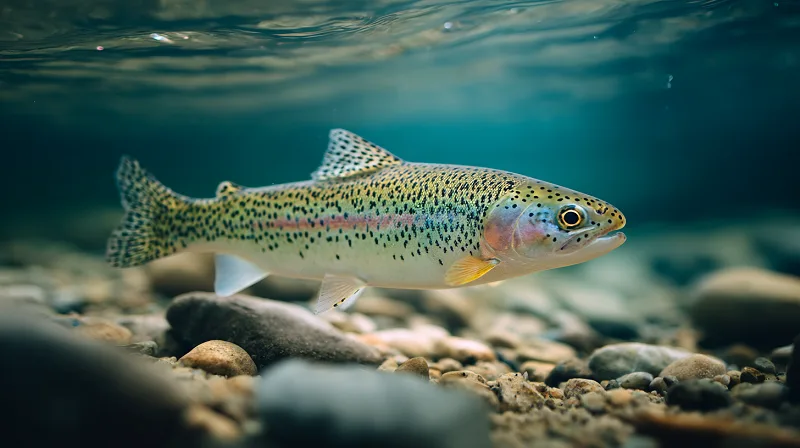
The digestive system of coldwater fish, like trout, with its true acidic stomach, numerous pyloric appendages, and short intestines (unlike warm-water fish such as carp), indicates that the physiology of this species is uniquely designed for digesting and absorbing high levels of protein and fat with exceptional digestibility; a reality that underscores the need for precision in formulating coldwater extruded feed (Figure 1).
Acidic Stomach with High Protein Digestibility:
The trout’s stomach creates a highly acidic pH environment (between 2 and 3) due to hydrochloric acid (HCl) and pepsinogen secretion, which is essential for breaking down complex protein structures and hydrolyzing peptide bonds. In this process, the quality of raw protein and its thermal processing play a determining role in the gastric evacuation rate.
The Strategic Role of Pyloric Caeca:
The presence of numerous pyloric caeca at the junction of the pylorus and the anterior intestine significantly increases the surface area for contact and absorption of nutrients. This section is not only active in secreting enterokinase and peptidases, but is also the main site for hydrolyzing lipid micelles derived from bile and pancreatic lipase secretions.

Physiological Limitations in Carbohydrate Metabolism:
Rainbow trout inherently have limited amylase activity and due to the structure of glucose transporters (GLUT4), experienc a state similar to “glucose intolerance” at high levels of raw starch. Therefore, starch in the coldwater fish feed must achieve a gelatinization rate of over 85 to 90 percent through precise extrusion cooking to reduce liver metabolic load.
Pancreatic Secretions and Lipid Digestion:
The high dependency of trout’s basal metabolism on unsaturated fatty acids (HUFA) necessitates the absorption of fats in the small intestine, guaranteed by a rich secretion of bile salts and pancreatic esterases.
A deep understanding of the digestive physiology of aquatic species allows the R&D and diet formulation team at Sedad Daneh Novin to design feed in alignment with trout anatomy:
- Maximize the apparent digestibility (ADC) of proteins and amino acids.
- Prevent intestinal mucosal inflammation caused by anti-nutritional factors (ANFs).
- Align gut passage rates with feed size and texture to minimize nutrient waste and improve FCR.
Biochemical Foundations and Coldwater Fish Diet Formulation
Scientific formulation in the aquaculture industry goes beyond the simple combination of raw materials; it is the art of biochemical engineering to precisely meet the metabolic needs of fish. At Sedad Daneh Novin, we formulate not based on “crude protein,” but on “meeting actual needs.” Our goal in trout nutrition is to reduce environmental impacts (through lower nitrogen waste) and increase economic efficiency.
Crude Protein vs. Digestible Protein (DP) and Amino Acid Profile
In the professional world of formulation, relying on the indicator of “crude protein” is a strategic mistake. Crude protein only represents the amount of nitrogen in the diet but does not indicate how much of it is actually absorbed by the fish. Fish require “ideal protein”; that is, a combination of amino acids that precisely matches their bodily needs. Limitations in key amino acids such as lysine (Lysine) and methionine (Methionine) can halt the entire protein synthesis process. If the levels of these amino acids are low, fish will deaminate excess proteins and excrete them as ammonia, which leads to both cost waste and water pollution. Our formulations, relying on mathematical amino acid balance formulas, prevent this waste and maximize muscle protein synthesis.
Essential Fatty Acids (EPA/DHA) and the Role of Fats in Protein-Sparing Effect
Fats in trout diets serve two critical functions: providing concentrated energy and supplying essential components of cell membranes. The protein-sparing effect mechanism is one of our advanced techniques. If the energy level of the diet is not optimal, the fish is forced to use the expensive proteins in the diet for energy production (for vital activities). We carefully balance the energy-to-protein ratio to consider fat as the primary fuel, allowing protein to be directly utilized for muscle building.
Moreover, the presence of optimal levels of long-chain fatty acids (PUFA), namely EPA and DHA, is essential for the health of the immune system, neurological development, and even the quality of fish meat texture. A deficiency of these fatty acids not only limits growth but also reduces meat quality and decreases its shelf life.
Stable Vitamins, Organic Minerals, and Astaxanthin Pigments
Micronutrients in our formulation do not play a “supplementary role;” they serve a “vital role.” The difference between a standard feed and Sedad Daneh Novin’s specialized feed lies in the stability of these components.
For example, vitamin C, due to its high sensitivity to heat and oxidation, is one of the first ingredients to be depleted during the extrusion process. If the stability of the vitamin in the diet is not guaranteed, the fish will experience oxidative stress and its immune system will weaken. At Sedad Daneh Novin, we use advanced coating techniques and select stable sources to ensure that vitamins are available to fish throughout all stages from production to consumption.
Additionally, using organic minerals (Chelated Minerals) instead of inorganic minerals ensures better absorption and less excretion of heavy metals in the environment due to higher bioavailability. Finally, to meet market standards and add value to the final product, astaxanthin pigment (Astaxanthin) can be incorporated into the diet. This pigment not only gives the appealing red color to trout meat, but also acts as a powerful antioxidant, protecting fish cells against environmental stressors.
Growth Stages and Size-specific Feeding Guide for Trout
Feeding in aquaculture is not a static process; rather, it is a dynamic program that must align with the growth curve and metabolic needs of fish at various life stages (ontogeny).
Starter and Micro-pellet Feed
The hatchery stage is the most sensitive period in a fish’s life. At this stage, fish are highly sensitive to water quality and the digestibility of the diet. Starter and micro-pellet feeds are produced with the highest protein quality and a very soft texture to minimize stress on the undeveloped digestive system of fry.
The use of crumble technology at this stage allows the creation of precise and uniform-sized particles that remain suspended in water and stimulate the appetite of fish fry. The high stability of these particles in water prevents substrate pollution and increases the organic load in the pond, ensuring the survival of the fry population under high densities.
Grower Feed
As fish enter the rapid growth stage, the management of grower feed for trout becomes the heart of farm profitability. At this stage, the goal is to reduce FCR and achieve maximum weight gain in the shortest time. Our produced feeds in sizes of 3 to 6 mm, utilizing advanced extrusion technology, have controlled density (floatability or sinkability) to be compatible with various farming systems (such as open flow or closed circuits).
Physical stability (high PDI) in this size of feed is critical; as fish have a high appetite at this stage, if the feed breaks down before consumption, it not only wastes costs but also severely degrades water quality. Our Grower formulation establishes a precise balance between energy and protein to ensure optimal muscle building instead of the storage of excess fat.
Specialized Broodstock Feed and Biological Granulation
Feeding broodstock is not solely about fish growth; it is an investment for the next generation.
Our main goal at this stage is to improve reproductive performance indicators such as “hatchability,” egg quality, and larval survival post-hatching. By adding astaxanthin and high levels of essential fatty acids, nutrient reserves in egg yolks are ensured and maximized, giving the resulting offspring a stronger immune system from the outset to face environmental challenges. This means a strong start for the next generation, beginning with your high-quality feed.
Differences Between Extruded and Pressed Pellets (Extrusion vs. Traditional Pelleting)
In selecting suitable feed, understanding the fundamental differences between extruded trout feed and pellets is essential for farm managers. While the traditional pelleting method only compresses materials into pellet shape through low-level pressure and temperature, extrusion technology is a complex thermo-mechanical process that changes the molecular structure of raw materials. This structural change is the main difference in terms of digestibility, stability in water, and ultimately, conversion rate (FCR). At Sedad Daneh Novin, we utilize advanced extruders to transfer the cooking process into the feed core, yielding a product with superior functional qualities.
The Phenomenon of Starch Gelatinization and Increasing Bioefficiency
The most significant competitive advantage of extrusion is the occurrence of starch gelatinization during the process. In traditional pelleting methods, the starch present in raw materials (such as corn or wheat) remains raw. Since coldwater fish have very limited capacity to secrete amylase for digesting raw starch, this type of feed leads to digestive problems and energy excretion in the form of feces.
However, in the extrusion technology of Sedad Daneh Novin, a combination of high pressure, temperature, and moisture causes the crystalline structure of the grains to break down and form a uniform gel. This gelatinization transforms starch from an indigestible state to a bioavailable state. The result of this process is a significant increase in bioavailability efficiency and a reduction in the metabolic burden on the liver; as fish can easily absorb energy from the gut, waste excretion that leads to water pollution is minimized.
Vacuum Coating Technology and Fat Injection
Another major challenge in producing coldwater fish feed is the uniform distribution and stability of lipids (fats) in the pellet structure. In traditional methods, fats are typically sprayed onto the pellet surface at the final stage, leading to rapid oxidation of fats and a decline in feed quality during storage.
In this advanced vacuum coating process, feeds are placed in a vacuum chamber after extrusion, and fats are injected into the porous structure of the feed under pressure. This method has two vital advantages:
1. Uniform distribution: Fats are distributed throughout the entire length and width of the feed rather than settling on the surface, improving palatability and stimulating appetite.
2. Preservation and stability: Injection in a vacuum prevents direct contact of fats with atmospheric oxygen, thus preventing oxidation (rancidity). This means valuable fats like EPA and DHA are available to the fish until consumption, preventing the loss of nutritional quality.
Quality Control Standards and Physical Specifications of Extruded Pellets
At Sedad Daneh Novin, we believe that the quality of a feed is not solely summarized by laboratory analyses (protein and fat), but “feed physics” determines the final performance in the farm. The physical stability of extruded feed is directly related to cost management, maintaining water quality, and preventing nutrient waste. We utilize modern quality control equipment to match the physical parameters of each batch produced against standards before it leaves the factory to ensure that the feed experiences minimal deformation or crushing during transport and within farm bins.
Feed Durability Index (PDI) and Waste Optimization
Feed durability index (PDI) indicates the mechanical resistance of feed to impact and wear. Feed with low PDI becomes “fines” during handling and unloading phases in warehouses. The production of fines in fish feed is an economic nightmare: these small particles are not only poorly consumed by fish but also increase the organic load and decrease dissolved oxygen, jeopardizing water health.
Water Stability and Sink/Float Rate
Water stability is a measure of how long the feed retains its original structure in an aqueous environment. Sedad Daneh Novin’s extruded feeds are engineered to have high structural stability to prevent the phenomenon of “nutrient leaching.” If the feed disintegrates quickly in water, essential micronutrients (such as vitamins and minerals) dissolve in the water before reaching the fish’s mouth, leading to waste.
In the extrusion process, by meticulously controlling the porosity of the feed, we can manage the feed sink/float rate. For systems with high water flow or specific management needs, feeds with precise sink or float rates are necessary. These physical adjustments allow the growers to confidently tailor their feeding strategy based on fish behavior in the water column, ensuring that every gram of feed reaches the fish with its original quality and formulation.
Key Formulations, Temperature Tables, and Smart Feeding Management
Modern management in trout farms is based on “data-driven” approaches and precise mathematical calculations. Overfeeding not only wastes capital in the form of uneaten feed and degrades water quality but underfeeding also suppresses the genetic growth potential of the stock. At Sedad Daneh Novin, we consider the continuous monitoring of biological parameters and adjusting feeding rates according to temperature fluctuations as the key to optimizing farm profitability.
How to Calculate Feed Conversion Ratio (FCR) and Specific Growth Rate (SGR)
To evaluate the biological and economic efficiency of feed, two fundamental indicators are calculated during each biometry period:
Feed Conversion Ratio (Feed Conversion Ratio – FCR):
This indicator shows the amount of dry feed consumed for producing one kilogram of fish meat:
The higher the physical stability and digestibility of extruded feed, the closer this number will be to 1 or even less.
Specific Growth Rate (Specific Growth Rate – SGR):
This indicator calculates the percentage of daily weight increase of the stock based on the natural logarithm:
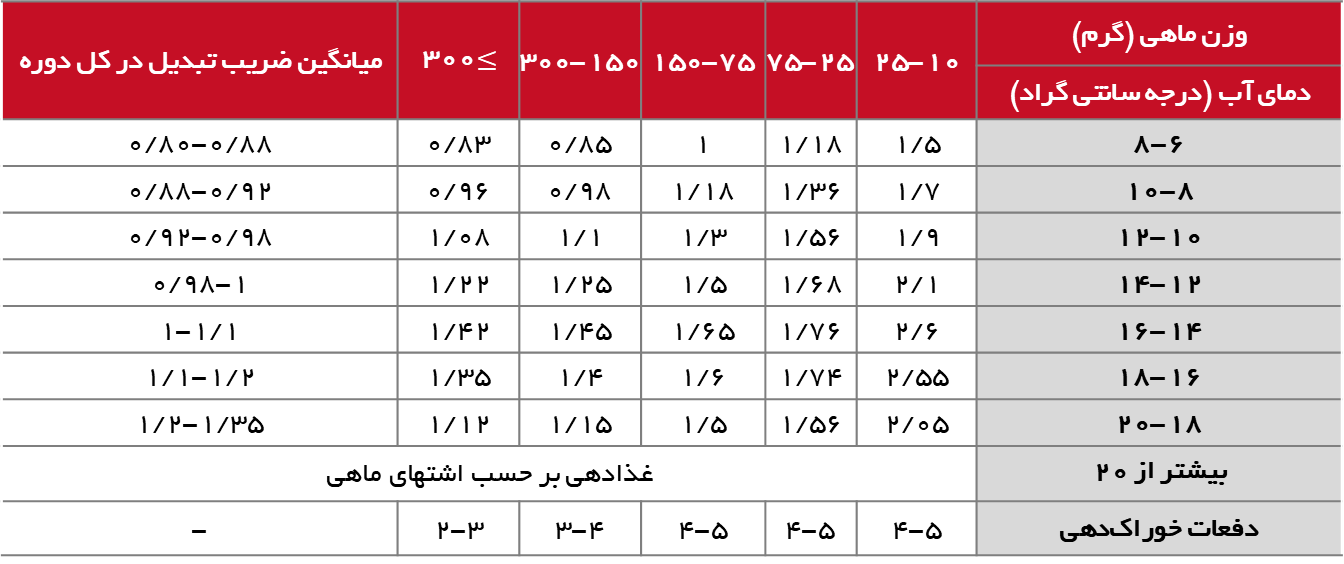
Comparative Table of Feeding Rates According to Temperature and Live Biomass Weight
Coldwater fish are ectothermic, and their metabolic rate is directly dependent on water temperature. The trout feeding table below provides a standard guide for daily feeding percentage
based on the percentage of live biomass (Biomass %):
Common Managerial Mistakes in Feeding Coldwater Fish
Feeding management in trout farms is a fine line between maximizing profitability and economic loss. Even with the use of high-quality extruded feed, feeding errors at the farm level can severely suppress the biological efficiency of the stock. Based on field evaluations by the technical team of Sedad Daneh Novin, the three most common errors cause the most damage to farms:
Neglecting the relationship between temperature and dissolved oxygen (DO): Feeding heavily when oxygen levels drop below mg/L6 imposes severe metabolic burdens on fish (SDA or the thermal effect of food). In conditions of oxygen depletion or peak daily temperature, incomplete digestion occurs, and the risk of asphyxiation and mortality of the stock increases exponentially.
Overfeeding (Over-feeding) and Nutrient Leaching: Overfeeding at one feeding session not only pollutes the water and wastes capital, it also causes rapid passage of feed through the digestive tract and reduces the effectiveness of proteolytic enzymes.
Improper Sizing of Feed Based on Biomass: Mismatched feed size to the fish’s mouth diameter harms in two ways: excessively fine feed leads to extra energy expenditure for scavenging particles and increases fines; excessively coarse feed also unnaturally prolongs retention time in the stomach, intensifying the risk of ulcers and intestinal inflammation.
Failure to Adjust Diet After Environmental Stresses: Continuing heavy feeding immediately after grading, transport, or medical treatment, due to cortisol secretion and weakened digestion, directly degrades the feed conversion ratio (FCR).
Why Choose Sedad Daneh Novin Coldwater Fish Feed?
Choosing the right feed is the most decisive step in ensuring profitability and economic efficiency for trout farms. Sedad Daneh Novin relies on practical D&R research and understanding farm challenges to establish its qualitative distinction based on two fundamental principles:
Sustainable Supply of Quality Raw Materials and Consistent Quality from Batch to Batch:
The biggest challenge for growers is the continuous changes in analysis and quality of feed throughout the farming cycle. Sedad Daneh Novin creates a sustainable supply network and consistently uses high-quality fish meal with controlled TVN, easily digestible proteins, and oils rich in essential fatty acids (EPA / DHA), ensuring that every batch sent to the farm has a completely uniform biochemical analysis and nutritional value. This quality consistency prevents any digestive shocks, growth declines, or fluctuations in the feed conversion ratio (FCR).
Targeted Use of Specialized, Bioactive, and Next-Generation Additives:
We enrich our feeds not only to meet basic nutritional needs but also with immune enhancers, prebiotics, chelated (organic) minerals, heat-stable vitamins, and antioxidants. These functional compounds minimize losses due to environmental stresses, handling, and seasonal fluctuations by strengthening the intestinal mucosal barrier, preventing intestinal inflammations, and enhancing the fish’s innate immunity, thereby ensuring the health and vitality of the stock.
Frequently Asked Questions about Cold Water Fish Nutrition
1. What is the best time and frequency for feeding salmon during the day?
Feeding should be done during oxygen-rich hours of the day while maintaining temperature stability. For fry (under 20 grams), 4 to 5 feedings are recommended, while for grow-out fish, 2 to 3 evenly distributed feedings per day are advised.
2. What action is necessary for feed management during temperature fluctuations or oxygen drop?
When the dissolved oxygen level drops below normal values, feeding should be stopped or the amount of feed should be reduced based on the severity and extent of the situation. For example, at temperatures above 18 degrees Celsius or with oxygen levels below 5 mg/L, due to decreased digestive capacity and metabolic stress, feeding rates should be reduced by 30 to 50 percent or temporarily stopped.
3. What is the difference between Sada Deneh Novin extruded feed and regular pellet feed?
The extrusion process, with complete gelatinization of starch, increases the pellet durability index (PDI >95%) and optimizes water stability, leading to maximum digestion, reduced fines, and a significant improvement in the feed conversion ratio (FCR) compared to regular pellets.
Conclusion and Guide to Ordering Specialized Feed
Choosing the right feed is one of the most important factors in achieving uniform growth, stock health, and reducing the feed conversion ratio in trout farms. The optimal performance of feed is not only dependent on its protein and fat percentage but also on the quality of raw materials, digestibility, types of functional additives, pellet size, and the compatibility of the feed with fish weight, water temperature, and farm management conditions.
Sada Deneh Novin, relying on a sustainable supply of high-quality raw materials, consistent batch control, and targeted use of specialized additives, produces feeds tailored to the needs of cold water fish. For selecting the appropriate product, the company experts can provide specialized guidance based on the average fish weight, biomass, water temperature, water quality, and cultivation goals.
For nutritional advice, selecting the size and type of feed, price inquiries, and placing orders, share your farm information and stock specifications with Sada Deneh Novin experts for the most suitable feeding program and product recommendations.