
Garlic: A Valuable Functional Feed Additive in Aquaculture
In recent years, the use of plant-based feed additives in aquaculture has gained considerable attention due to increasing restrictions on antibiotic use and growing concerns about antimicrobial resistance. Among medicinal plants, garlic (Allium sativum) is one of the most extensively studied natural additives because of its antibacterial, antifungal, antiviral, antioxidant, and immunostimulatory properties.
Numerous studies have shown that the proper inclusion of garlic in aquafeeds can improve disease resistance, enhance growth performance, strengthen the immune system, and contribute to the overall health of aquatic species. However, the effectiveness of garlic depends on several factors, including the cultured species, dosage, feeding duration, farming conditions, and the form in which garlic is processed. Therefore, understanding its bioactive compounds and mechanisms of action is essential for its effective application in aquaculture nutrition.
How Do Garlic’s Bioactive Compounds Work?
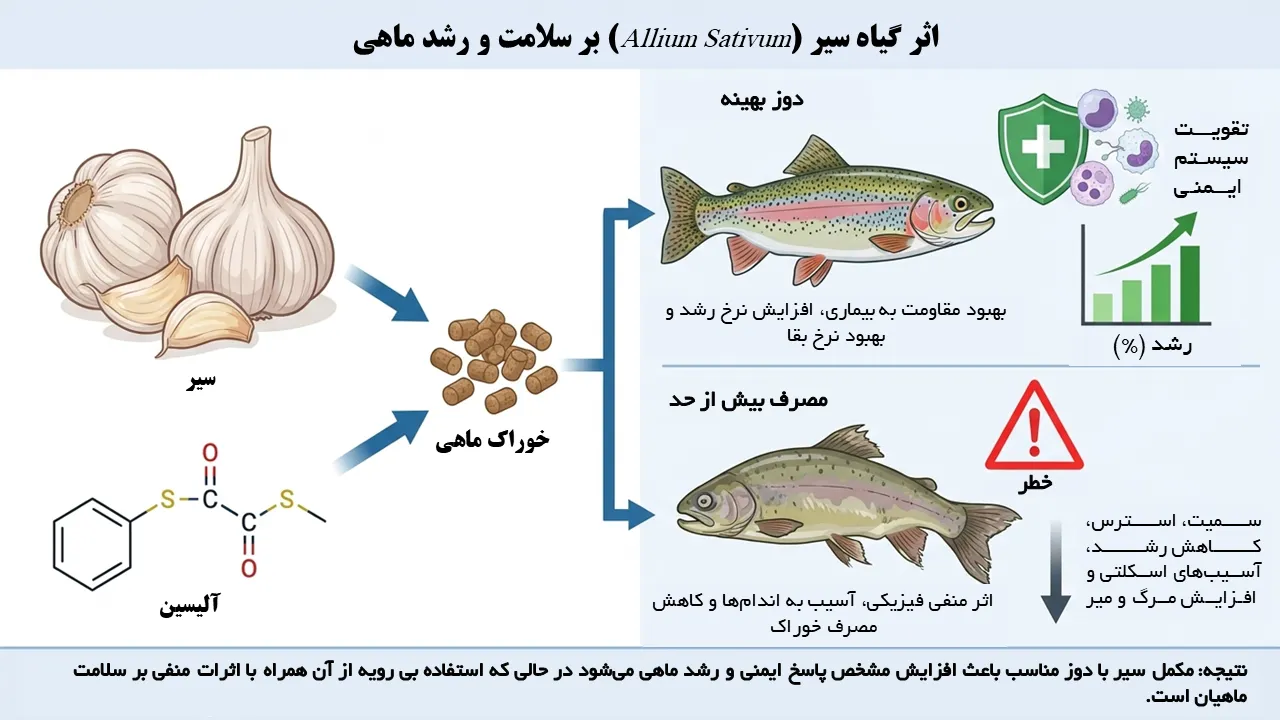
Many of garlic’s biological and therapeutic properties are attributed to its sulfur-containing compounds, particularly alliin and allicin, which are considered the primary active constituents responsible for its health-promoting effects.
Interestingly, fresh garlic does not naturally contain active allicin. Instead, when garlic cloves are crushed, chopped, or ground, plant cells are damaged, releasing an enzyme called alliinase. This enzyme converts alliin into allicin through an enzymatic reaction. Consequently, breaking the garlic tissue is a necessary step for allicin formation and activation of many of garlic’s biological properties.
Besides giving garlic its characteristic aroma, allicin is largely responsible for its antimicrobial, anti-inflammatory, antioxidant, and immune-enhancing activities, making it a key compound in aquaculture research.
Garlic Is Rich in Bioactive Components
The nutritional and medicinal value of garlic extends far beyond allicin alone. Garlic contains a wide range of biologically active compounds that contribute to the health and performance of aquatic animals. These include prostaglandins, polysulfides, glycosides, sulfinates, pectin, adenosine, essential amino acids, fatty acids, vitamins A, B1, B2, B6, C, and E, biotin, and various trace minerals.
One particularly important micronutrient found in garlic is selenium, which plays a significant role in maintaining immune function and reducing oxidative stress, thereby helping aquatic animals better resist environmental stressors and infectious diseases.
In addition, garlic extracts have been reported to possess antibacterial, antiviral, antifungal, hypolipidemic, hypocholesterolemic, hypoglycemic, and anticoagulant properties. Many of these beneficial effects are closely associated with garlic’s sulfur-containing compounds.
The Role of Garlic in Strengthening the Immune System of Aquatic Animals
One of the main reasons garlic has attracted attention in aquaculture is its ability to enhance immune function. Farmed aquatic species are frequently exposed to environmental stress, fluctuating water quality, and infectious pathogens. Under such conditions, dietary additives capable of stimulating the immune response are of great practical value.
Research indicates that alliin, and particularly allicin, can stimulate immune cell activity and improve the body’s natural defense mechanisms against pathogens. These compounds also help regulate inflammatory responses while inhibiting the growth of certain harmful microorganisms.
In one study conducted on rainbow trout, dietary supplementation with 0.3, 0.45, and 0.6 g of garlic powder per daily feed ration for 15 days significantly increased the number of white blood cells and neutrophils. These findings indicate an enhanced innate immune response and improved disease resistance in this species.
The Antioxidant Role of Garlic Flavonoids
In addition to sulfur-containing compounds, garlic is also rich in phenolic flavonoids, which are recognized as natural antioxidants.
These compounds protect cells from oxidative damage caused by free radicals and help reduce oxidative stress. This is particularly important in aquaculture, where intensive farming, temperature fluctuations, transportation, and disease outbreaks can significantly increase oxidative stress.
The presence of these antioxidant compounds may also explain part of garlic’s protective and antibiotic-like effects observed in various studies.
Effects of Garlic on Growth Performance in Rainbow Trout
Improving growth performance is one of the primary objectives of dietary supplementation in aquaculture. Consequently, numerous studies have investigated the influence of garlic on growth-related parameters.
Research evaluating different concentrations of alcoholic garlic extract demonstrated that dietary inclusion levels ranging from 0.1% to 0.2% positively influenced the growth performance of rainbow trout. However, the same study reported that excessive supplementation produced adverse effects on absolute growth, highlighting the importance of appropriate dosage.
These findings emphasize that increasing the amount of garlic does not necessarily lead to better performance and that optimal inclusion levels are essential for achieving desirable results.
Findings of Khodadadi’s Study (2021)
Khodadadi (2021) investigated the effects of dietary garlic powder at inclusion levels of 0.5%, 1%, 1.5%, and 2% in rainbow trout with an average initial body weight of 41.3 g. A commercial BioMar feed was used as the basal diet.
The results demonstrated that garlic supplementation significantly affected the specific growth rate and weight gain. Among all treatments, the diet containing 1% garlic powder produced the highest specific growth rate, suggesting that moderate supplementation provides the greatest benefit.
These findings further confirm that selecting an appropriate inclusion level is critical for maximizing garlic’s effectiveness in aquaculture feeds.
Garlic Supplementation in Nile Tilapia
The beneficial effects of garlic are not limited to rainbow trout. In another study involving juvenile Nile tilapia, dietary garlic supplementation for two months did not produce significant differences in growth performance.
However, when the feeding period was extended to eight months, significant improvements in growth parameters were observed. These results suggest that the duration of supplementation is another important factor influencing garlic’s effectiveness, with some benefits becoming evident only after long-term feeding.
Effects of Garlic on Body Composition
Besides improving growth performance, garlic may also influence the body composition of aquatic species.
One study evaluated diets containing 1%, 2%, and 3% garlic powder for rainbow trout. The results showed that fish receiving 3% garlic powder exhibited significant differences in body composition compared with the control group, including changes in crude protein, crude fat, and ash content.
These findings indicate that garlic supplementation may improve not only growth but also carcass quality and nutrient composition.
Garlic and the Control of Bacterial Diseases
Another important application of garlic in aquaculture is its potential role in controlling bacterial infections. Bacterial diseases are among the leading causes of economic losses in fish farming, increasing the demand for natural alternatives to antibiotics.
Several studies have demonstrated that garlic supplementation can help control Aeromonas hydrophila infections in rainbow trout while simultaneously improving growth performance and feed intake.
In another investigation, dietary supplementation with 0.5 g of garlic per kilogram of feed in hybrid tilapia significantly increased leukocyte counts, enhanced phagocytic activity, and improved several immune-related enzymatic functions.
Similarly, dietary inclusion of 1% garlic has been reported to improve growth performance in Siberian sturgeon, suggesting that garlic can be effectively applied across various cultured fish species.
Can Excessive Garlic Supplementation Be Harmful?
Although garlic offers numerous health benefits, excessive supplementation may produce undesirable effects.
A study by Moghadam and colleagues (2015) evaluated the toxicity and median lethal concentration of hydroalcoholic garlic extract in juvenile fish. The results showed that despite the valuable biological activities of allicin and other active compounds, excessive intake could lead to loss of balance, severe muscle contractions, spinal curvature, toxicity, and ultimately mortality.
These findings highlight the importance of determining appropriate dietary inclusion levels and using garlic responsibly in aquaculture feeds.
Conclusion
Garlic is considered one of the most promising functional plant-based feed additives in modern aquaculture. Owing to its bioactive compounds—including alliin, allicin, flavonoids, selenium, and numerous other beneficial constituents—it has the potential to improve immune function, enhance disease resistance, promote growth performance, and positively influence body composition in cultured aquatic species.
Studies conducted on species such as rainbow trout, Nile tilapia, and Siberian sturgeon consistently support the beneficial effects of garlic supplementation. Nevertheless, its effectiveness depends on factors such as dosage, processing method, feeding duration, cultured species, initial body weight, and farming conditions.
Therefore, garlic should be incorporated into aquafeeds based on scientific evidence and at appropriate inclusion levels to maximize its benefits while minimizing the potential adverse effects associated with excessive use.