
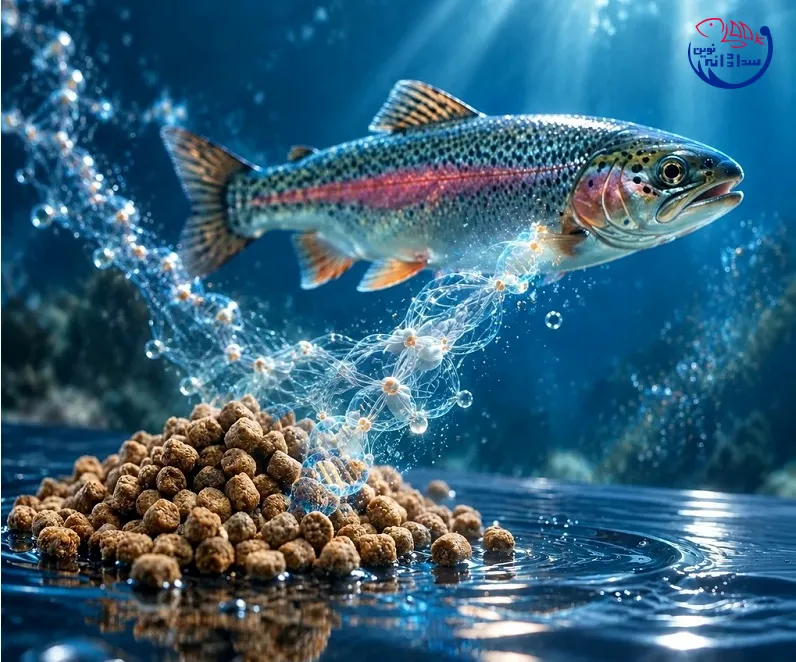
Feeding cost crisis and the importance of protein efficiency in aquaculture
In the economic structure of modern aquaculture, feed accounts for more than 60 to 70% of the total ongoing costs of farms. In this context, protein— as the most expensive component of the aquatic animal diet— makes up the largest share of the cost of every kilogram of feed. For years, traditional market thinking has assumed that higher crude protein means faster growth and better performance; however, the biological reality of fish is completely different. Providing high protein in the diet does not necessarily mean greater growth, because if amino acids are not absorbed into muscle tissue due to insufficient energy or poor-quality raw materials, instead of being used to build flesh, they are oxidized as an energy source or excreted as ammonia.
Today, with fluctuations in the market for feed inputs and limitations in water resources, intelligent feeding in the industrial rearing of rainbow trout in Iran has moved beyond a competitive advantage and become a necessity for economic survival. Leading producers, instead of focusing solely on the protein percentage on the bag label, have directed their attention to “protein utilization efficiency.” This is where a precise understanding of the concept of “protein retention” and how it interacts with the physical and chemical quality of feed defines the line between sustainable profitability or severe loss in farms.
What is Protein Retention in Aquatic Species? Formula and Indicators
In the physiology of nutrition, not all nutrients that are ingested follow the same pathway. The concept of protein retention in aquatic species, in simple terms, describes what proportion of the crude protein consumed is actually synthesized in the fish body and remains as muscle tissue (fillet). In the modern aquafeed production industry, this index is considered the final measure of the diet’s biological quality.
The difference between “ingested protein” and “stored protein” in the fish body
To understand the roots of this process, the metabolic pathway must be broken down. Ingested protein must first be hydrolyzed in the digestive tract, and its amino acids must be absorbed into the bloodstream. Part of these amino acids is used to maintain basic body functions (Maintenance), to renew enzymes and the intestinal lining. Another portion, in the event of amino acid imbalance or a lack of non-protein energy, undergoes deamination (Deamination) and is burned as fuel; the result of this is nitrogen release and the loss of ammonia through the gills. Only the fraction that precipitates as recombinant protein in the muscle mass is called “stored protein.”
Biological formula for calculating protein retention efficiency (Protein Efficiency Ratio=PRE)
The protein retention efficiency index is calculated as a percentage based on precise chemical analysis of fish biomass:
. The closer this number is to the optimal range of 35 to 45%, the more efficient the formulation performs.
Why is protein retention vital for rainbow trout producers in Iran?
Cold-water fish farming in our country has faced, in recent years, fundamental changes and multiple economic constraints. Rearing rainbow trout in Iran is mainly based on open-water systems (flowing water discharge) or intensive pond-based farms; where the slightest drop in the diet’s physiological performance is negatively reflected on farm profitability in an exponential manner. In this context, the protein retention rate is not merely a parameter for laboratory testing, but the first line of economic defense of the producer against production risks.
Climatic challenges, water temperature fluctuations, and limitations of protein resources
Iran’s climate in different seasons comes with significant temperature changes; from severe winter cold in the mountainous regions of the Alborz and Zagros to summer heat stress that brings the pond water temperature to the danger threshold. Trout is a cold-blooded organism and water temperature dictates its metabolic rate. During temperature stress, if the dietary protein does not have high digestibility and high retention capacity, the fish will spend more energy on excreting excess compounds. On the other hand, imports and stable access to high-quality fish meal and high-grade protein sources in the domestic market are always accompanied by exchange-rate fluctuations; therefore, maximizing the use of each unit of formulated protein is the only cost-management solution for feed.
The direct effect of protein retention on reducing organic load in water and ammonia excretion
Protein that is not retained in the fish’s muscle tissue must be deaminated in the liver and excreted as ammonia (NH3) through the gills and fecal mass. Ammonia dissolved in pond water becomes toxic rapidly and even at low concentrations causes damage to gill tissue, reduces dissolved oxygen uptake, and severely suppresses the rainbow trout immune system. Improving nitrogen retention reduces the biological and organic load of the discharged water and moderates the need for heavy water replacement in the country’s drought crisis conditions.
The economic value of saving every gram of protein in the farm’s final profit
From the viewpoint of production economics, reducing nitrogen waste means direct improvement of the feed conversion ratio in aquaculture. When feed is processed in such a way that the share of stored protein increases from 30% to 40%, the farmer will need hundreds of kilograms less feed for each ton of produced biomass. This saving controls the costly feed expense and guarantees the final profit margins of rainbow trout producers in today’s highly competitive market.
Physical and chemical feed characteristics that minimize protein wastage
Many producers attribute the decline in growth performance solely to a lack of protein percentage on the diet analysis sheet; however, in modern aquafeed engineering, physical characteristics and the feed matrix structure play a role on par with chemical formulation. If the feed structure cannot trap the nutrients within it until complete ingestion, or if its bioavailability decreases due to improper processing, a large portion of the protein will be lost before entering the fish’s metabolic cycle. Detailed evaluation of feed characteristics is the key to sealing the “leaks” of dry matter and nitrogen loss.
Water stability (Water Stability) and the leaching phenomenon of amino acids
Unlike land animals that feed in solid environments, aquatic species feed in a liquid environment; therefore, the contact time between feed and water is highly decisive. If hydrocolloidal bonds and feed density are weak, the leaching (Nutrient Leaching) phenomenon begins within a few minutes. Free amino acids with low molecular weight, dipeptides, and water-soluble vitamins are the fastest substances that seep from the feed wall into the water column. In such conditions, the feed ingested by the fish effectively becomes deficient in the profile of essential amino acids, and the protein retention efficiency drops sharply due to disruption of the balance of limiting amino acids.
Pellet Durability Index (PDI) and the amount of fines: prevention of biochemical spoilage
The pellet durability index (Pellet Durability Index – PDI) is a metric that shows the physical ability of the feed pellet against abrasion, displacement in pneumatic lines, road transport, and automatic feeding systems. Feeds with PDI less than 95% break quickly and produce a high percentage of fines (Fines). Fines are not only not captured by rainbow trout and represent direct loss of capital, but they also settle at the pond bottom or in mechanical filters and, by accelerating the activity of heterotrophic bacteria, consume dissolved oxygen and produce ammonia. High mechanical durability ensures that every gram of protein produced in the factory reaches the fish’s mouth without physical breakage.
The role of extrusion technology and gelatinization in the bioavailability of protein
In advanced production lines, extrusion technology performs wet cooking with precise combinations of moisture, high pressure, and shear force. This process results in complete gelatinization of starch (more than 85 to 90%) and forms an elastic, unified sponge-like network around the protein granules. On the other hand, mild and controlled extruder heat denatures anti-nutritional factors (Anti-Nutritional Factors) such as trypsin inhibitors present in plant meals and maximizes the ability of the fish digestive proteolytic enzymes to access peptide chains, without damaging heat-sensitive amino acids such as lysine (preventing uncontrolled Maillard reaction).
The secret of balancing energy and protein: the protein-sparing effect
For fish to survive, swim, and maintain cellular homeostasis, they need a continuous biological fuel supply. The top priority of aquatic physiology is always “supplying basic energy,” not synthesizing flesh. If the diet cannot provide sufficient and available non-protein energy, the fish immediately channels expensive amino acids into the Krebs cycle and burns them. This is where the physiological phenomenon Protein-Sparing Effect becomes a formulation strategy that can rescue performance.
When lipids take on the burden of energy supply
As a specialized carnivore, rainbow trout is far more capable at oxidizing fats to produce adenosine triphosphate (ATP) than at digesting complex carbohydrates. By increasing the level of quality fats with high digestibility in the feed, most of the body’s caloric load shifts onto triglycerides and free fatty acids. As a result, essential amino acids such as lysine and methionine are spared from deamination, pointless catabolism, and conversion into fuel in the liver; this event allows peptide chains to be directed entirely toward their ultimate goal—building new muscle fibers and enabling longitudinal growth of the fillet.
The optimal DP/DE ratio at different growth stages of rainbow trout
The key to engineering this effect is the precise adjustment of the ratio of digestible protein to digestible energy (DP/DE Ratio) according to grams per megajoule (MJ/g). The metabolic requirement of rainbow trout changes across different body weights:
Larval and fry stages: Due to the high rate of cell division, a higher DP/DE ratio (about 22 to 24 grams per megajoule) is required.
Grow-out stages and end of the period: Additional energy needs and slower tissue building increase; therefore, the DP/DE ratio decreases to about 16 to 19 grams per megajoule, and the share of fat energy goes higher.
Inhibiting protein catabolism in the factory through precise formulation
Preventing amino acid catabolism requires designing formulations based on “ideal and digestible amino acids” instead of the nominal crude protein percentage. In advanced factories, by combining monitoring of moisture, precise vacuum coating of fat on extruded feeds, and accurately balancing total energy, the stability of the fish’s cellular energy is established. This level of industrial precision ensures that even one gram of excess protein is not wasted due to energy deficiency and that peak growth efficiency is recorded.
The engineering and knowledge-based approach of the company “Sedad Dane Novin” in improving protein retention
In the era of industrial competition and input crises, achieving maximum efficiency in a herd cannot be done solely by relying on general formulas. The knowledge-based group of Sedad Dane Novin, by integrating advanced material-analysis laboratories, nutrition biology, and process engineering, has implemented new standards in the production of aquafeed in the country. The ultimate goal of our production lines is that every feed pellet delivered to the pond results in the highest protein retention rate and the lowest possible excretion load.
Quality monitoring and formulation based on the profile of ideal amino acids
At Sedad Dane Novin, the traditional diet formulation concept based on “crude protein” has been replaced with the precise balancing of an “ideal digestible amino acid profile.” Raw materials are evaluated before entering the production line through accurate spectrometric and biochemical analyses, and potential deficiencies of limiting amino acids such as lysine and methionine are balanced with formulations. This symmetrical pattern ensures that rainbow trout muscle protein synthesis occurs without any metabolic bottlenecks and with minimal nitrogen loss.
Precise control of extrusion parameters, feed density, and vacuum coating
Sustainable industrial pellet production requires precise alignment of feed characteristics with the fish’s biological needs. In the Sedad Dane Novin extruded production lines, the starch gelatinization rate, radial expansion level, and the apparent density of the feeds are continuously monitored with control systems so that the feed’s cellular structure reaches peak mechanical resistance (PDI above 98%). The use of advanced vacuum coating technology (Vacuum Coating) ensures that sources of unsaturated fatty acids and functional additives penetrate deep into the feed matrix and provide a stable energy source for the fish’s protein-sparing effect, without being washed into the water column.
Ensuring the least dry matter loss and preserving growth factors in farms
The result of this scientific approach is a near-zero reduction in fines, no physical breakdown of pellets in water for many minutes, and maximum uptake of micronutrients. Field tests in the country’s cold-water farms have shown that feeding specialized Sedad Dane Novin feeds not only guides FCR into the optimal range, but also, by keeping pond water clear and reducing physiological stresses, unlocks the full genetic potential of trout for flourishing.
Frequently asked questions about protein retention in aquatic species
1. Does a higher crude protein percentage (CP) mean better protein retention?
No; crude protein only indicates the total nitrogen level in the diet. If the diet does not have a suitable amino acid balance, or if it suffers from a lack of non-protein energy (fat), most excess protein is catabolized to supply energy instead of building fillet tissue and is excreted as ammonia.
2. How much does extrusion feed stability in water affect protein uptake in trout?
Very much; feeds with a weak sponge-like structure in the early minutes after entering water undergo the leaching (Leaching) phenomenon. This event causes rapid leakage of free amino acids and soluble dipeptides into the water column and strips the ingested pellet of growth factors.
3. What is the most important factor in improving protein retention in rainbow trout farms in Iran?
The combination of formulation based on digestible amino acids, precise adjustment of the protein-to-energy ratio (DP/DE), and the use of extruded feed with high physical durability (PDI above 95%) to prevent physical and biochemical nitrogen loss into the water.
Conclusion: No wasted protein—guaranteed profit for the farmer
In modern aquaculture economics, success is not measured by the assessed tonnage of incoming feed; rather, it is based on protein, gram by gram, that is converted into profitable muscle tissue. Every percentage improvement in nitrogen retention means a direct reduction in the feed conversion ratio (FCR), healthier pond water, and your farm’s economic durability against fluctuations in the input market.
The D&R team experts and technical consultants of Sedad Dane Novin are with you to implement the most optimized feeding patterns and specialized rainbow trout diets by evaluating your farm’s climatic and biological conditions. Contact us to receive formulation consultation and product catalog information.